
· by Michael Blair, Nashville's Gutters
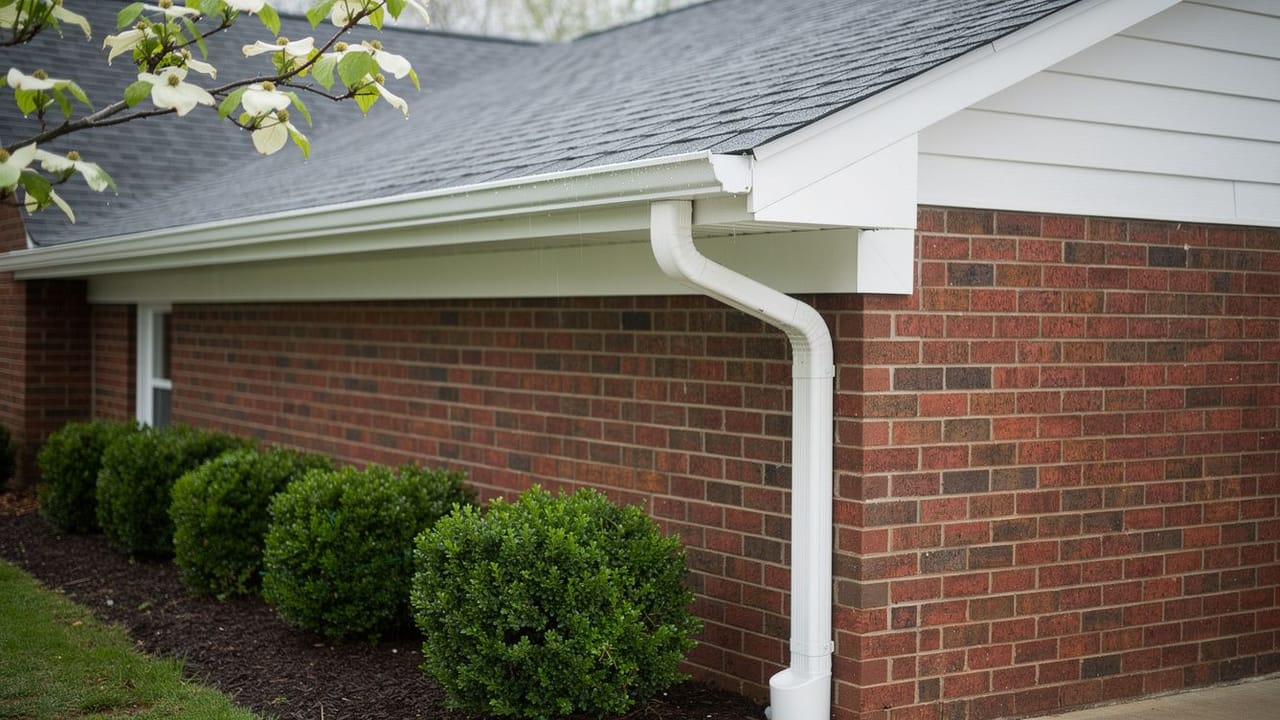
When a gutter leaks, we look at the joints first, because that is where the water usually gets out. A sectional gutter comes in precut lengths that are joined on the house, and Alside’s rainware sell sheet lists the slip joint connector that links one section to the next, so there is a joint wherever two lengths meet, plus every corner and every outlet. A seamless gutter is roll-formed on site from a coil of aluminum and cut to the length of the eave. The same sheet says most professional contractors fabricate gutters that way, and that the result has fewer joints than sectional gutter. That difference is why our seamless gutter installation is what we put on houses, and it is also why the joints that remain deserve more attention than they usually get.
Where do sectional gutters leak?
Each joint on a sectional run depends on the connector and whatever seals it, and that seal is pulled and pushed by summer heat and winter cold year after year. When one lets go, what we tend to find is a row of drip marks in the mulch under that joint, and the fascia behind it gone soft, since a slow leak lands on the same few inches of wood every time it rains. The reseal itself is covered in our post on gutters leaking at the seams.
Sectional gutter is sold by the piece, which makes it the gutter a homeowner can hang without a forming machine. So on a leaking sectional run we check the slope, the hanger spacing and where the outlets were placed along with the joints themselves. A run that falls the wrong way leaves water sitting in the trough after the storm has passed, and when the standing water is over a joint, that joint is the one we find leaking.
What seamless gets right, and what it does not
One piece per run means no joints partway along a straight eave. Alside’s gutters and downspouts page describes the gutter being fabricated on site by the installer from color-matched coil, so the profile is the same end to end and the length is whatever the eave measures. Thickness is worth asking about: the sell sheet lists its gutter coil in .027 and .032, in 5-inch and 6-inch sizes. The same sheet carries both the older spike, a metal post driven through the gutter, and hangers that fasten with a screw; we hang ours on screw-in hangers into the fascia and set the spacing for the run.
The joints that remain are corners, end caps and outlets. The sell sheet’s parts list has box miters and strip miters for the corners, end caps for the ends of a run, and outlet tubes that connect the gutter to the downpipe, and each of those is a place where two pieces of metal meet. A miter that is cut badly or sealed thinly will drip the way any sectional joint does, so ask how the corners are made and what goes inside them. At the downspout, look for a purpose-made outlet fastened into the bottom of the trough. A hole with a downspout pushed up into it is the version that leaks.
- Mid-run joints: none on seamless, one wherever two sectional lengths meet
- Corners, end caps and outlets: joints on both systems, so ask how they are sealed
- Hangers: which kind, and how far apart
- Coil: whether the quote is for .027 or .032
When does sectional gutter still make sense?
A short run on a shed or a detached garage, a repair to one damaged section on a house that already has sectional gutters, or a stretch so short and awkward that bringing in the forming machine makes little sense: for those, sectional is a reasonable choice. On the main runs of a house, we would rather remove the joints than maintain them.
Copper and steel are a separate decision, with their own ways of joining one piece to the next, and on an older house with half-round copper the real question is matching what is already there. That comparison has its own post, on aluminum, copper or steel gutters.
What to check on a seamless quote
The size. Coil is sold for 5-inch and 6-inch gutters, and which one a house needs comes down to how much roof drains to each run and how many downspouts share it, which is the arithmetic in our post on sizing gutters for a Nashville downpour. Give the downspouts as much attention as the gutter. NOAA’s Atlas 14 precipitation frequency estimates for Nashville put the five-minute rainfall in a ten-year storm at about 0.57 inch, a rate close to 7 inches an hour, and a downspout that is too small or in the wrong place lets a well-hung gutter overflow in a burst like that. Then the fascia: a screw-in hanger needs sound wood to bite into, so we replace any soft fascia behind the old gutter before the new one goes up, which is the work of our fascia and soffit repair.
Get the coil thickness in writing, ask about the hanger spacing, and ask what happens at the corners. Alside backs its aluminum gutters and rainware with a twenty-year limited warranty, and its sell sheet adds that the warranty does not apply to damage caused by faulty or improper installation, which is the plainest reason to ask those three questions before anyone climbs a ladder. If you would like the answers for your own house, ask us for an estimate.
Sources
- Alside, Aluminum Gutter Coil and Rainware Systems sell sheet (10/24) — Slip joint connectors between sections; most contractors fabricate on site with fewer joints than sectional; .027 and .032 coil in 5-inch and 6-inch; spikes and screw hangers; box and strip miters, end caps, outlet tubes; twenty-year limited warranty excluding improper installation
- Alside, Gutters and Downspouts product page — Gutters fabricated on site by the installer from color-matched gutter coil
- NOAA National Weather Service, Atlas 14 precipitation frequency estimates for Nashville — Ten-year five-minute rainfall depth of 0.571 inch at Nashville (about 6.9 inches an hour)
FAQ
Seamless or Sectional Gutters, and Why It Matters — questions
Are seamless gutters worth the extra cost?
On a house, we think so. Taking out the joints partway along each run removes most of the places a gutter can leak, and because the installer forms and hangs the run, the slope and the hangers are set in the same visit. The price difference depends on the house, so ask for both on the same quote and weigh it against what a leaking joint does to the fascia behind it.
Do seamless gutters ever leak?
Yes, at the corners, end caps and outlets, which are still joints. A poorly cut miter drips like any seam. Sealant inside the miter, a purpose-made outlet and a look at those points every few years keep them sound.
Can a seamless gutter be repaired if a section is damaged?
Usually. We either cut out the damaged length and join in a new piece, which adds two sealed joints to a run that had none, or form a new run to length on site and replace the whole thing. Which we recommend depends on how long the run is and the shape the rest of it is in.
How are seamless gutters made?
On site, by the installer. A forming machine at the house rolls color-matched aluminum coil into the gutter profile and cuts each piece to the length of the eave it will hang on. The coil comes in .027 and .032 thickness for 5-inch and 6-inch gutter, so ask which one your quote uses.